Z80 CPU
- Category: Microprocessor ICs
- Sub Category: Z80 CPU
- Manufacturer: Zilog
Short Description
Z80 8-bit Microprocessor
General Description
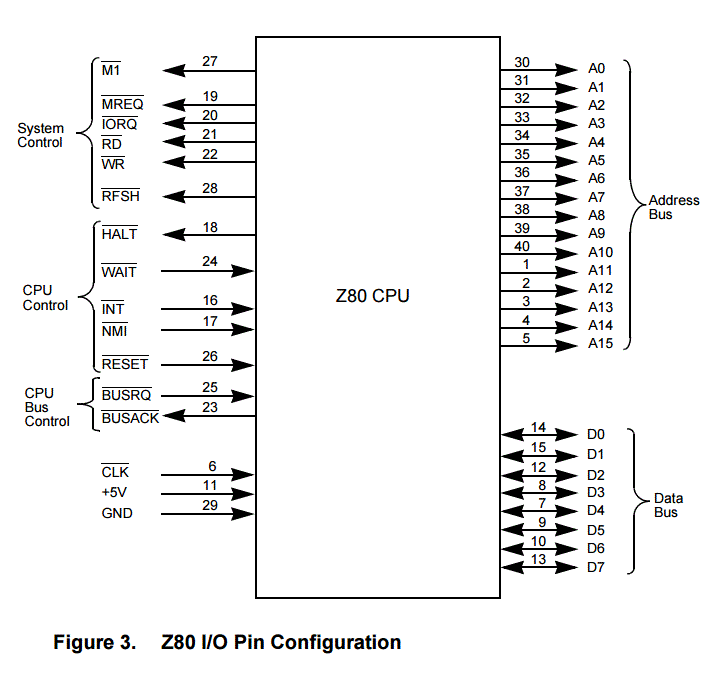
The ZiLOG Z80 CPU family of components are fourth-generation enhanced microprocessors with exceptional computational power. They offer higher system throughput and more efficient memory utilization than comparable second- and third-generation microprocessors. The speed offerings from 6– 20 MHz suit a wide range of applications which migrate software. The internal registers contain 208 bits of read/write memory that are accessible to the programmer. These registers include two sets of six general purpose registers which may be used individually as either 8-bit registers or as 16-bit register pairs. In addition, there are two sets of accumulator and flag registers. The Z80 CPU also contains a Stack Pointer, Program Counter, two index registers, a REFRESH register, and an INTERRUPT register. The CPU is easy to incorporate into a system since it requires only a single +5V power source. All output signals are fully decoded and timed to control standard memory or peripheral circuits; the Z80 CPU is supported by an extensive family of peripheral controllers.
Features
#An enhanced instruction set[13] including bit manipulation, block move, block input/output (I/O), and byte search instructions</br> #New IX and IY index registers with instructions for direct base+offset addressing</br>#A better interrupt system</br> #A more automatic and general vectorized interrupt system, mode 2, primarily intended for Zilog's line of counter/timers, DMA and communications controllers, as well as a fixed vector interrupt system, mode 1, for simple systems with minimal hardware (with mode 0 being the 8080-compatible mode).</br>#A non maskable interrupt (NMI) which can be used to respond to power down situations and/or other high priority events (and allowing a minimalistic Z80 system to easily implement a two-level interrupt scheme in mode 1).</br>#Two separate register files, which could be quickly switched, to speed up response to interrupts such as fast asynchronous event handlers or a multitasking dispatcher. Although they were not intended as extra registers for general code, they were nevertheless used that way in some applications.</br>#Less hardware required for power supply, clock generation and interface to memory and I/O</br>#Single 5-volt power supply (the 8080 needed -5 V/+5 V/+12 V)</br># Single-phase 5 V clock (the 8080 needed a high-amplitude (9 to 12 volt) non-overlapping two-phase clock)</br>#A built-in DRAM refresh mechanism that would otherwise have to be provided by external circuitry</br>#Non-multiplexed buses (the 8080 had state-signals multiplexed onto the data bus)</br>#A special reset function which clears only the program counter so that a single Z80 CPU could be used in a development system such as an in-circuit emulator
Applications
Microprocessor Based Projects.
Absolute Maximum Rating
###
Datasheet Link
http://www.z80.info/zip/z80cpu_um.pdf